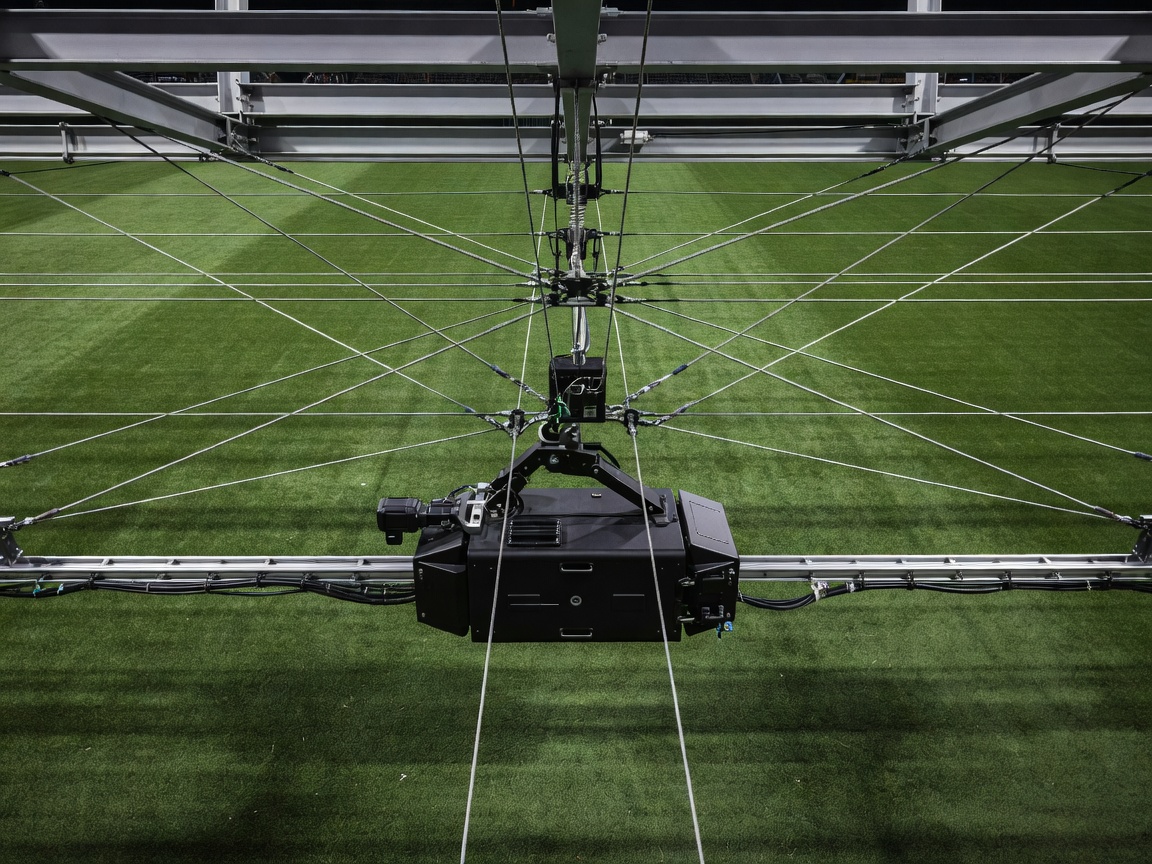
Camera system / overhead
Looking Down on Play
Start with a broad view of the playing surface: an overhead camera can make spacing, routes, and changing patterns easier to read. The rig and operational plan determine whether that perspective can be delivered safely and consistently.
Trace the coverage01 / Make the playing surface legible
The shot overhead makes possible
An overhead camera changes how a viewer understands a game. From above, movement can be read as shape: players open a channel, a formation shifts, a ball travels through a crowded area, or a race line bends across a circuit. The perspective is especially useful when the relationship between several subjects matters more than an isolated expression or close detail.
That view is not automatically the best view. A very high angle may communicate position while reducing a sense of speed or physical contact. A camera pointed almost vertically down can make depth and distance harder to judge. A diagonal overhead angle may retain more visual shape but show less of the full field. The production should describe the editorial reason for the camera before it specifies a mounting concept.
Consider when the source will be used. A tactical analysis segment may need a sustained, broad view. A live programme may use the camera briefly to establish spatial context. A replay may benefit from a particular elevated angle, but only if the moment is captured clearly and is available to the replay workflow. Each use suggests different framing, camera movement, and coordination needs.
Understand the rig as part of the system
Overhead camera arrangements may use a fixed mount, a suspended carriage, a cable-supported platform, or another engineered solution suited to the venue. These are not interchangeable kits that can be selected from an image alone. The structure, permitted attachment points, loads, travel path, access, and operating procedures require assessment by appropriately qualified rigging and venue professionals.
Before planning installation, identify the relevant venue contact and establish the applicable approval process. Ask what rigging information, drawings, inspection records, exclusion zones, and operational documentation are required. Clarify which party owns installation, inspection, operation, and removal. The production should also know how weather, event access, crowd activity, and changes to the venue configuration affect the plan.
A moving suspended system has a travel envelope. That envelope needs to be understood in relation to the playing area, lighting, scoreboards, roof structures, and any other equipment. A camera should not travel into an area that has not been assessed for the operation. Agree on speed limits and movement rules through the responsible system team rather than assuming the camera can move freely wherever the cable or track permits.
Plan the operator’s view and control
The operator needs a usable way to see the camera picture, judge movement, focus, and respond to production cues. Depending on the installation, operation may take place from a dedicated control station rather than at the camera. This makes return video and communications essential parts of the design. The operator and director need agreed language for camera readiness, movement, obstruction, and any condition that requires the system to stop or hold position.
Camera movement can add energy to a shot, but it also adds variables. A gradual traverse can reveal a pattern; a rapid move can distract from it or make it difficult to follow. A static overhead frame may be the clearer editorial choice. Rehearse representative moves and stationary compositions, establish safe start and stop points, and determine which movements are available during live play. The system’s operating rules take priority over a desired shot.
Connect the camera to the production desk
The path from an overhead camera to the control room may involve camera control, signal conversion, fiber or other transport, monitoring, routing, and communications. Map the complete route, including the camera’s power and control connections, return feed, tally if used, and the destination input. Check connector types, supported video formats, cable protection, patching responsibilities, and the method for confirming the source at the desk.
Remote control may let an operator adjust pan, tilt, zoom, focus, or system travel from a production position, depending on the installed equipment. Confirm what controls are actually available and which are restricted. Separate camera framing from rig travel in the operating plan if those functions are controlled differently. The director should understand the practical response time and limits of each control before relying on a move as a live cue.
Restrictions, contingencies, and handoffs
Overhead installations can be affected by structural limits, venue rules, event schedules, weather exposure, limited access windows, and other production equipment. They may also be unsuitable for some venues or events. A system may be technically possible yet not appropriate for the available rigging, sightlines, or operating window. Treat those constraints as design inputs, not as problems to solve after the camera is promised.
Agree how the production will respond if the camera is held, loses signal, or cannot be operated. A complementary elevated or fixed camera may offer a fallback, but the director needs to know which source is ready and what picture it provides. Include technical rehearsals in the schedule, verify the complete signal and control path, and rehearse any planned transition into or away from the overhead angle.
The strongest overhead picture is one that makes the sporting moment clearer while fitting the venue’s safety and production requirements. Begin with the shot, confirm the mount with the appropriate people, and carry the operating plan through to the live desk. For moving ground-level coverage, see tracking camera systems; for recorded review, read about the replay chain.
Signal path
From rig position to on-air angle
Operational constraints
Can any arena support an overhead camera?
No. Suitability depends on the venue structure, approval process, access, rigging options, operating conditions, sightlines, and qualified review. A camera concept should not be treated as an installation plan.
What makes an overhead view useful for replay?
A clear view of the relevant moment, a feed available to the replay system, and an agreed operational handoff. The angle’s value depends on what it can show, not only on its height.
Which teams need to be involved?
At minimum, involve the venue, qualified rigging and system personnel, production technical staff, camera operations, and the director. Confirm responsibilities for approvals, installation, testing, operation, and removal.